

We’re excited to share a charming (and cheeky!) new display at the museum: Behind Closed Drawers — a peek into the hidden world of women’s underwear. From sturdy corsets to elegant slips and practical bloomers, each piece offers a glimpse into how people lived, worked, and dressed in generations past.
It’s a wonderful reminder that even the most everyday items have history stitched into them — and often a story or two waiting to be told.
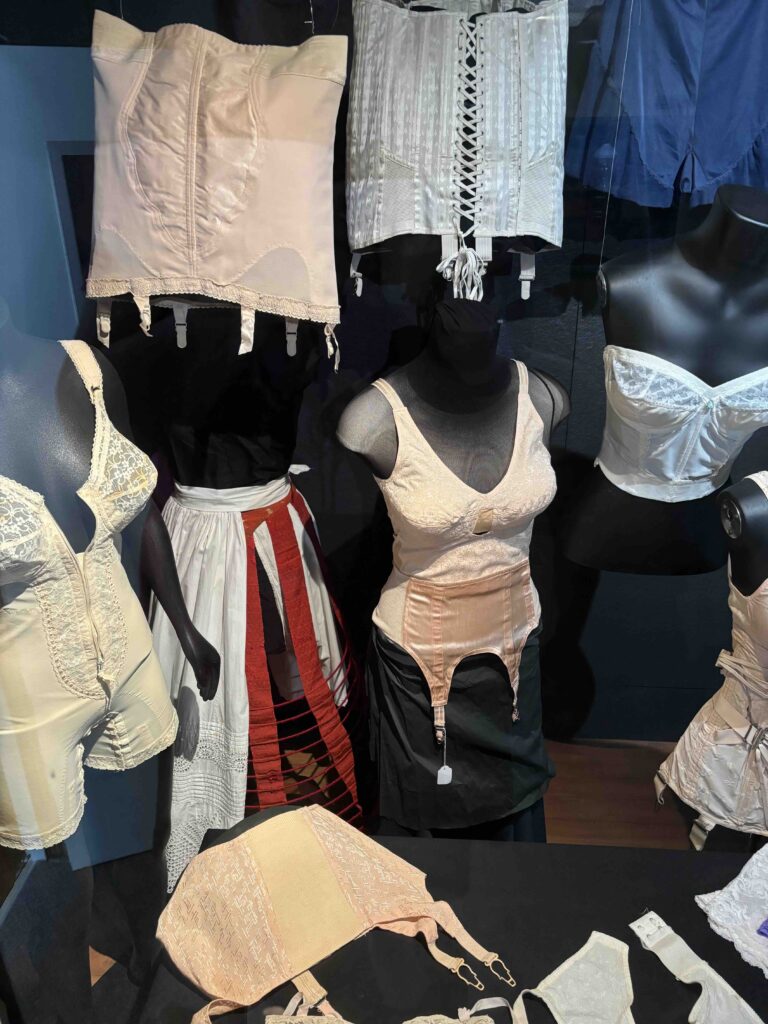

Museum Musings: Three generations of women’s underwear
Two different types of fabric were used in the past to manufacture women’s underpants – locknit was a thicker cotton fabric with a matt finish, and interlock was a thinner fabric with a shiny surface.
My grandmother had a Victorian childhood, and all her adult life she wore a corset. In her later years this was a large, flesh-coloured garment with whale bone stays and long laces and many hooks and eyes. Although they would have had suspenders attached she never used them (did she cut them off?) but kept her thick lisle stockings up by wearing garters. Her pants were locknit bloomers that came halfway down her thighs. On her upper body she wore a singlet with short sleeves. To a teenaged granddaughter, the wearing of a corset but no bra was unbelievable (how many young people know that bra is short for brassiére?).
My mother dispensed with a corset, but wore an elasticised girdle instead. The suspenders on this kept her stockings up – stockings were nylon after WWII. In the winter she wore locknit bloomers, and these conveniently kept the skin above the stocking tops warm. In the summer she wore scanties, which were made out of interlock fabric. They were shorter than bloomers and had a band of fabric around the legs, but no elastic there. During the 1920s when the flappers were in vogue, young women like my mother bound their breasts because of the fashion for flat-breasted dresses, but later on she wore a bra.
All my childhood I wore home-made pants. This was probably of necessity during the war years. Mum made them from white cotton fabric and they had short legs. As we spent most of our days outside of school wearing shorts, short legs were needed. Elastic in those days had no nylon reinforcing so wore out quite quickly. When the elastic in waist or legs became loose we would pull out a loop and tie a knot in it. A tragedy was when your knicker elastic broke, with the ignominy of them ending up around your ankles. As girls didn’t usually have pockets in their dresses, handkerchiefs were tucked up the legs of our pants.
In the early 1950s, when I was about to start high school, the shops started selling girls locknit pants with short lace-trimmed legs. We were delighted to have finally left our home-made pants behind. By that time most of us had developed enough to have to wear a bra. These, and our pants, were fashionably white. We felt sorry for one girl whose mother dressed her in brown pants and a flesh-coloured bra, and another girl from a very religious family had to wear black pants made out of a fabric called Italian cloth, as her mother considered them to be more modest. The daughter was longing for white Italian cloth to become available. Bra straps weren’t elasticised then, and on more than one occasion, after hitting a softball with force, my bra strap broke – damn!
Maureen Young December 2025